What Defines a Two-Player Board Game
A two-player board game is any board game built for exactly two people to compete head-to-head, with no teammates and no sitting through other players’ turns before you get another move. Three things separate one two-player game from another: whether both players see the entire game state (perfect information) or whether cards and tiles hide information; how much of the outcome depends on luck versus decision-making; and how long a single session runs, from a five-minute filler to a match stretching past an hour.
Chess: Structure, Rules, and Origins
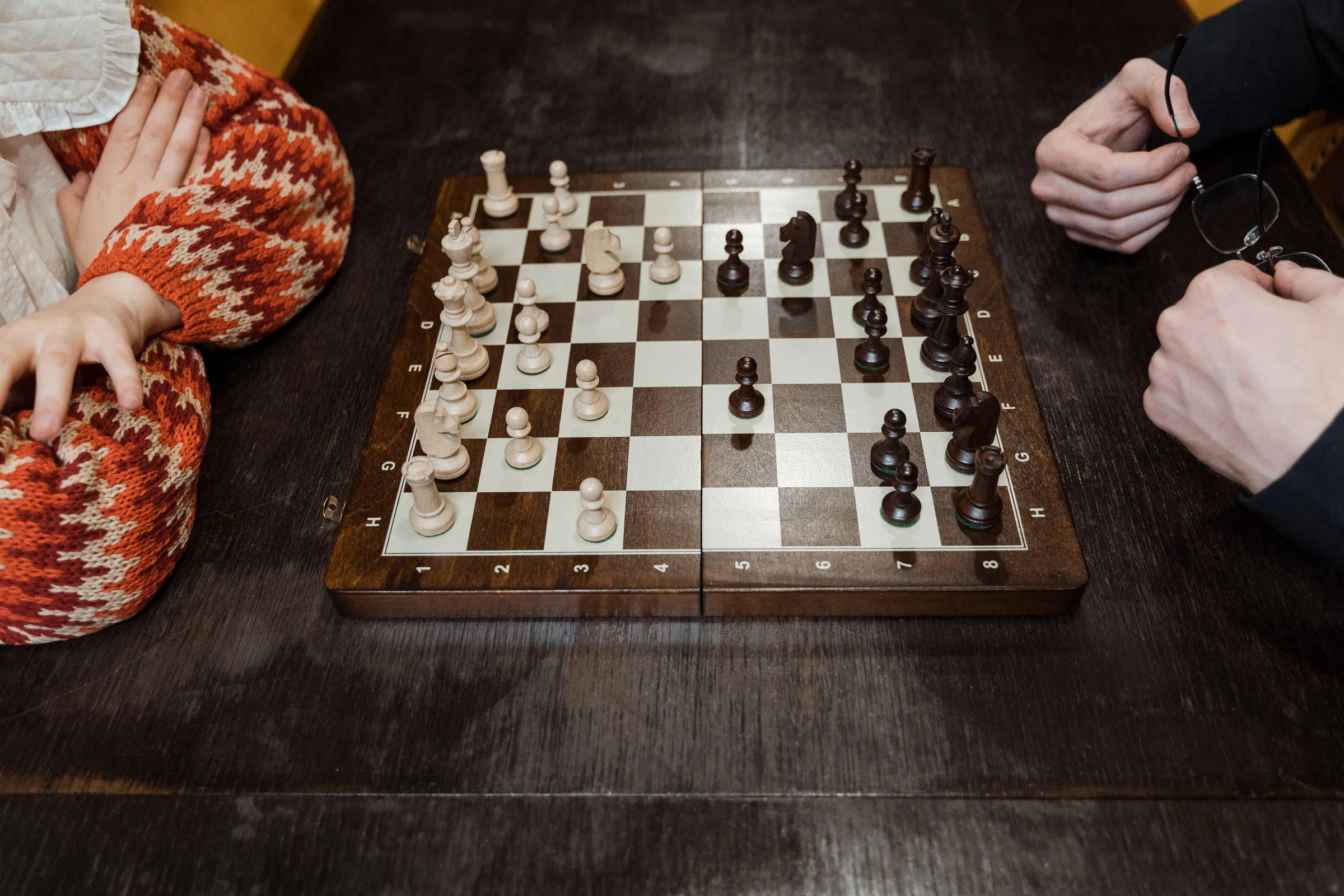
Chess is played on an 8×8 board of 64 alternating squares, with rules for piece movement, check, checkmate, and special moves like castling codified by FIDE, the International Chess Federation, in its official Laws of Chess. Those laws also define draw conditions — stalemate, threefold repetition, the 50-move rule — which is why chess games can go either way right up to the final moves.
Chess is believed to have originated in India as chaturanga around the 6th century CE, according to Encyclopaedia Britannica, spreading to Persia as shatranj before reaching Europe by roughly the 10th century. The modern rule set, including the queen’s wider range and castling, was largely standardized in Europe by the 15th and 16th centuries. FIDE sanctions several time control formats — classical, rapid, and blitz — for competitive play.
Go: Structure, Rules, and Origins
Go originated in China more than 2,500 years ago and later spread to Korea and Japan, according to Encyclopaedia Britannica, making it older than chess by a wide margin. The standard board is a 19×19 grid, though 9×9 and 13×13 boards are commonly used by beginners since a full match takes considerably longer. Players alternate placing black and white stones to surround territory and capture opposing stones; the game is decided by counting territory plus captures, and under most rule sets there’s no mechanism for a draw.
The International Go Federation coordinates national Go associations across dozens of countries and organizes events including the World Amateur Go Championship.
Chess vs. Go: Where the Two Diverge
Both are two-player, perfect-information, zero-luck contests, but they diverge in important ways. Chess pieces have fixed, unequal powers and the board empties as the game progresses, with checkmate as the goal. Go pieces are all identical and the board fills up, with the objective being territorial control. Chess quite often ends in a draw between closely matched players; Go, scored by counting territory and captures, has no built-in path to a tie under most rule sets.
The Wider World of Modern Two-Player Games
- Classic family abstract games: Checkers, Backgammon, Connect Four, and Mancala — shared boards with no hidden information.
- Modern abstract strategy games: Hive and Onitama, built specifically for two-player, no-luck competition.
- Hidden-information duels: Battleship and Stratego, giving each player a private setup the opponent can’t see.
- Card-and-board hybrids: Jaipur and Star Realms, combining a shared board or market row with private hands of cards.
- Purpose-built “duet” games: Codenames: Duet and Patchwork, designed around exactly two people from the start.
How to Choose a Game for You and One Other Player
- How long do you want to play? A round of Connect Four can be over in minutes; a full 19×19 Go board or long classical chess game can run well over an hour.
- Do you want a game to master over years, or one you can win occasionally on a lucky draw? Chess and Go reward long-term study; card- and dice-based games give a less experienced player a realistic shot.
- Do you prefer everything visible, or some hidden information? Abstract games like chess or Go suit direct position-reading; Battleship or Stratego suit bluffing and deduction.
- How much are you willing to learn upfront? Chess and Go both have simple core rules — the strategic depth built on top is what takes time.
FAQ
Which is older, chess or Go?
Go is considerably older — it originated in China more than 2,500 years ago, while chess is believed to have originated as chaturanga in India around the 6th century CE.
Are two-player games better for learning strategy than games with more players?
Two-player games remove the social and political layer multiplayer games introduce — there’s no forming alliances or being ganged up on. Every outcome traces directly back to a decision made by you or your one opponent.
Do you need special equipment to start, or can beginners use simpler boards?
Not necessarily. Go is traditionally played on a 19×19 board, but 9×9 and 13×13 boards are commonly used by beginners to shorten the game. Chess doesn’t have an equivalent smaller board, but faster time controls serve the same purpose.
Can casual players join organized chess or Go competitions?
Yes, in both cases. FIDE’s rated tournament structure includes classical, rapid, and blitz formats. The International Go Federation’s flagship two-player event, the World Amateur Go Championship, is coordinated through national member associations rather than limited to professionals.